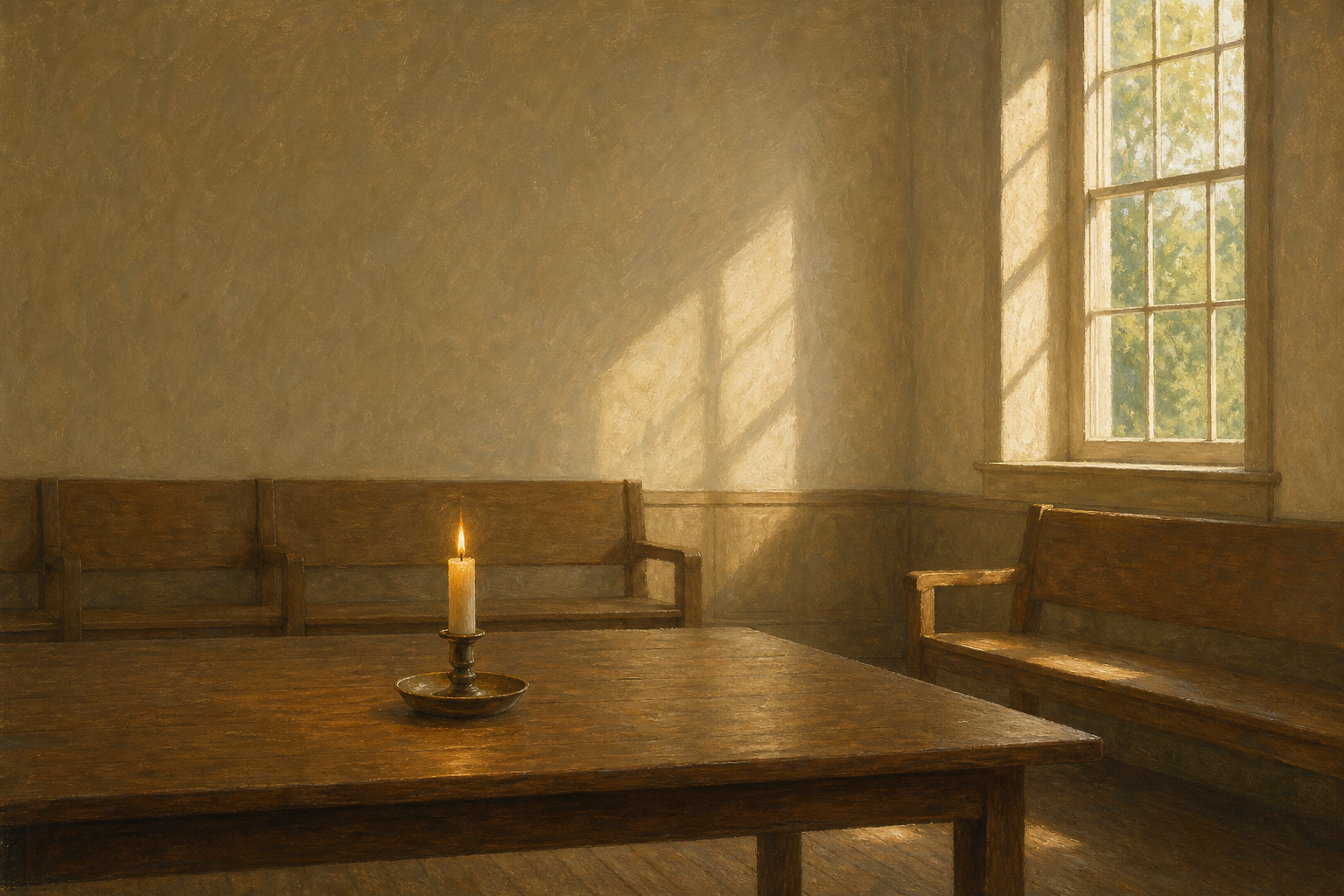
Quaker Simplicity and the Art of Enough
"Try to live simply. A simple lifestyle freely chosen is a source of strength. Do not be persuaded into buying what you do not need or cannot afford."
— Quaker Advices and Queries
There is a sentence buried in the collected Advices and Queries of the Religious Society of Friends that I have returned to more than any other in recent years. It is not theological in the conventional sense. It does not speak of God directly. It speaks instead of the relationship between a human being and the material world — and it does so with a directness that most religious writing carefully avoids. "Try to live simply. A simple lifestyle freely chosen is a source of strength."
The words "freely chosen" are doing enormous work in that sentence. They distinguish Quaker simplicity from asceticism, from poverty, from puritanical self-punishment. The Quakers are not asking anyone to live in deprivation. They are asking something harder: to make a conscious, deliberate choice, each day, not to accumulate beyond what genuinely serves a life of purpose. To know, in other words, what enough means for you — and to stop there.
In a culture that has elevated consumption into an identity and surplus into a virtue, that is a genuinely radical act.
The SPICES Framework: A Map of Integrated Living
The Quaker testimonies are sometimes summarized under the mnemonic SPICES: Simplicity, Peace, Integrity, Community, Equality, and Stewardship. The framing is pedagogically convenient, but it risks obscuring the more important point, which is that these six values are not separate commitments that one balances against each other — they are facets of a single integrated way of living. Each one implies and reinforces the others.
Consider the relationship between Simplicity and Integrity. The Ohio Valley Yearly Meeting document on Quaker testimonies states that integrity means "placing God at the center of one's life" — and then immediately adds that integrity means "refusing to place things other than God at the center of one's life, whether one's own self, possessions, the regard of others." The logic runs directly from simplicity to integrity and back again. A person who is not simple — who has organized their life around accumulation, status, or the opinion of their social circle — has, by this account, already compromised their integrity. Not through any single lie, but through the cumulative displacement of what matters by what merely shines.
The Quaker understanding of integrity is notably more demanding than the common usage. It is not merely about not lying or not cheating. It encompasses "personal wholeness and consistency" — the alignment between one's stated values and one's actual daily choices. A person can be technically truthful in every particular statement while still living a life of fundamental dishonesty, if the arc of their choices systematically misrepresents their own deepest commitments. The Quaker testimony to integrity refuses to allow this gap.
The testimony of Community, meanwhile, gives simplicity a social dimension that purely individualistic philosophies tend to miss. When the OVYM testimony notes that Friends "benefit from unearned, often unacknowledged and unrecognized privileges," it is pointing toward the relational cost of excess. Every dollar spent on what is not needed is a dollar withheld from what is genuinely needed by someone else. Simplicity is not merely personal hygiene; it is a form of neighbor-love made concrete.
And Stewardship connects simplicity to time itself: "Friends understand that each day and each hour is given to us as a gift. We seek patterns of living that enrich and refresh our spiritual and social lives." The Quaker objection to over-consumption is not, at its root, aesthetic or even ethical in a narrow sense. It is temporal. The person enslaved to accumulation has traded their hours — which are irreplaceable — for objects that are merely replaceable. The exchange is always a bad one.
George Fox and the Refusal of Performance
The Religious Society of Friends was founded in mid-seventeenth-century England by George Fox, a shoemaker's apprentice who became convinced, through years of spiritual searching, that the elaborate apparatus of institutional religion — its priests, its sacraments, its hierarchies, its costumes — stood between the individual soul and the direct experience of God. What Fox called the "Inward Light" or "Inner Teacher" was not a metaphor. He meant that each person carried within them the capacity for immediate divine encounter, without mediation.
The social and economic consequences of this conviction were profound. If all human beings equally carry the Inner Light, then the elaborate systems of deference that organized English society — the doffing of hats to magistrates, the swearing of oaths that implied a two-tiered standard of truth, the marking of rank through dress and address — were not merely inconvenient; they were spiritually dishonest. They performed a hierarchy that the Inner Light contradicted.
Fox's refusal to remove his hat before judges became famous, but the more consequential testimony was the one about oaths. Early Friends refused to swear oaths in court, preferring to "affirm" — because, as they argued, swearing an oath implied that one's ordinary speech might not be reliable. If a man could be trusted to tell the truth in court under oath, why was he not expected to tell the truth everywhere else? The Quaker insistence on "letting your yea be yea and your nay be nay" (James 5:12) was a demand for moral consistency across all registers of life, not only the formal and legal ones.
The dress testimony followed the same logic. Plain dress — avoiding the elaborate, costly fashions of the wealthy — was not primarily about money. It was about refusing to participate in a system of signals that ranked human beings according to their possessions rather than their characters. When early Quakers wore plain grey wool instead of the silks and laces of the gentry, they were making a statement about what they believed the external appearance of a person should communicate: not status, not wealth, not social ambition, but simply this is who I am.
George Fox wrote in 1656: "Be patterns, be examples in all countries, places, islands, nations, wherever you come, that your carriage and life may preach among all sorts of people, and to them; then you will come to walk cheerfully over the world, answering that of God in every one." The phrase "your carriage and life may preach" is telling. For Fox, the primary form of testimony was not speech but life as lived. The simplicity was itself the sermon.
Spinoza in the Lens-Grinder's Workshop
Baruch Spinoza would likely have found much to recognize in the Quaker testimonies, though he arrived at similar conclusions through the entirely different route of philosophical rationalism rather than Christian mysticism. The story of Spinoza grinding lenses in Amsterdam is well known: after his excommunication from the Amsterdam Jewish community in 1656 (roughly contemporaneous with Fox's early ministry), Spinoza refused both the wealthy patronage that could have insulated him from material concern and the academic positions that would have required him to moderate his philosophical views. He chose the grinding wheel.
This was not poverty chosen in despair. It was simplicity chosen in service of what he called sub specie aeternitatis — the view from eternity. Spinoza's philosophical system held that the highest human good was the intellectual love of God, the understanding of the universe as a single infinite substance. The passions — including the passions for wealth, status, and approval — were obstacles to this understanding, not because they were morally bad but because they were cognitively distorting. A person enslaved to passions could not reason clearly about what truly served their deepest interests.
Spinoza's concept of conatus — the fundamental striving of any entity to persist in its own being — is often misread as a license for acquisitive self-interest. The opposite is closer to the truth. For Spinoza, the highest expression of conatus in a rational human being was not the accumulation of external goods but the cultivation of the capacity for understanding. The person who squanders their hours chasing what they do not need is, paradoxically, working against their own conatus — trading the durable good (rational comprehension, freedom of mind) for the transient good (possession, status).
Seneca had made a related argument nearly two millennia earlier, in terms that any Quaker would recognize: "Dum differtur vita transcurrit" — "While we are postponing, life speeds by." Or, more directly: "Non refert quam multos libros habeas, sed quam bonos" — "It is not how many books you have, but how good they are." The Stoic critique of accumulation was not that wealth was evil, but that the pursuit of wealth beyond what was needed for a free and dignified life was a form of confusion about ends and means.
Franklin's Thirteen Virtues: Quakerism in Secular Code
Benjamin Franklin was not formally a Quaker, but he grew up in Boston among Quaker influences, and spent much of his adult life in Philadelphia, which had been founded by the Quaker William Penn on principles of religious tolerance, equitable governance, and plain living. Franklin's thirteen virtues, which he described in his Autobiography and practiced through his famous self-improvement ledger, read in several places like a translation of Quaker testimony into secular, practical language.
The virtue of Frugality he defined as: "Make no expense but to do good to others or yourself; i.e., waste nothing." The virtue of Sincerity: "Use no hurtful deceit; think innocently and justly, and, if you speak, speak accordingly." The virtue of Justice: "Wrong none by doing injuries, or omitting the benefits that are your duty." These are not identical to the Quaker testimonies, but they rhyme with them at every point — the emphasis on the alignment of inner state and outward action, the suspicion of waste, the primacy of fair dealing.
Franklin's Poor Richard's Almanack, published for twenty-five consecutive years beginning in 1732, was in many respects a vehicle for the practical ethics of simplicity. The maxims are well known to the point of cliché — "A penny saved is a penny earned," "Early to bed and early to rise," "God helps those that help themselves" — but in their original context they carried a specific social argument. Franklin was writing for working people: tradespeople, artisans, farmers, the sort of people who lived by their labor and were perpetually one bad harvest or one bad debt away from ruin. For these readers, frugality was not a lifestyle preference; it was a survival strategy and a form of dignity.
The connection between simplicity and dignity appears, in a different register, in the Quaker business tradition. When Quaker businessmen — the Cadburys, the Rowntrees, the Frys — established fixed prices for their goods rather than haggling, they were refusing to participate in a transaction model premised on mutual deception. The seller who sets a high price and then negotiates down has, by the Quaker account, already committed a small act of dishonesty by treating the initial price as fictional. The fixed price was a form of structural honesty, and it proved commercially effective: the Quaker reputation for fair dealing drew customers who valued certainty over the possibility of a better deal through sharp bargaining.
For Poor Richard, the accumulation of wealth was legitimate — Franklin was no ascetic — but it was legitimate only as a means to independence and public usefulness, never as an end in itself. The farmer who saved enough to own his land outright was no longer subject to the demands of landlords; the tradesman who kept his accounts in order was immune to the catastrophes that ruined those who lived beyond their means. Frugality created freedom. It was the material foundation of that self-possession without which civic virtue was impossible.
"Enough" as Radical Concept
The word enough has largely been expelled from the vocabulary of modern consumer economics. Growth, in the dominant discourse, is always desirable. More is always better than less. The aspiration to sufficiency — to a state in which one has what one needs and stops — is treated as evidence of limited ambition, low self-esteem, or failure of nerve.
This was not always so. The classical tradition, both Greek and Roman, had a robust concept of to hikanon — sufficiency, enough. Aristotle in the Nicomachean Ethics distinguished between chrematistike — the art of moneymaking, in pursuit of which accumulation had no natural limit — and oikonomia, the management of a household, which was governed by the principle of sufficiency. A household had needs; when those needs were met, the purpose of oikonomia was accomplished. The pursuit of wealth beyond that point was a category error, the application of a means-logic (accumulation serves needs) to a context in which the needs had already been met.
Aristotle considered unlimited wealth-seeking a form of character disorder, because it displaced the proper ends of human life — friendship, contemplation, civic participation, the exercise of virtue — with an activity that could never, by its own logic, reach completion.
The Quaker testimony to simplicity is, at its deepest level, a recovery of this classical insight in a specifically Christian idiom. The Advices and Queries state it directly: "Do not be persuaded into buying what you do not need or cannot afford." The "do not need" is the crucial phrase. Quaker simplicity does not oppose possession as such. It opposes the confusion of wants with needs — the progressive escalation of desire that characterizes a consumer culture, in which each acquisition generates rather than satisfies the appetite for more.
The testimony on wealth and accumulation in the OVYM document is remarkable for its psychological precision: "Habits of industry and thrift sometimes degenerate into love for wealth and its accumulation." The word "degenerate" is chosen carefully. Industry and thrift are virtues; the love of wealth is a corruption that can grow from those very virtues. The person who begins by saving what they need can, without noticing the transition, become a person who accumulates for the sake of accumulation — who can no longer distinguish between the resource and the aim. Clear accounts, the document advises, are "essential to keep Friends aware of their resources and expenditures." The discipline of accounting is, among other things, a discipline of self-knowledge.
Simplicity and the Long View: What Stewardship Requires
The ecological dimension of Quaker simplicity is among its most prescient aspects, and the one that connects most directly to the long-term thinking that characterizes the best of the investment tradition.
The OVYM testimony states: "The ongoing exploitation of the Earth's resources threatens the delicate ecological balance that sustains the current web of life. In 2002, Ohio Valley Yearly Meeting Friends found unity around the principle of sustainability as a basic standard for responsible living." This is not a recent addition grafted onto an older tradition; it flows directly from the original testimony. If the earth and its resources are a gift — if "each day and each hour is given to us" — then our relationship to natural resources is necessarily one of stewardship rather than ownership. A steward does not consume the principal; they preserve it and return it, if possible, enhanced.
The investment corollary is direct. Quaker guidance on financial stewardship is explicit: "Friends should be cautious in starting a business without requisite capital and experience, or of engaging in risky ventures in order to acquire abnormal profits." And: "In our relations with corporations as stockholders, Friends should be governed by the same high standards as in our relations with individuals. If the conduct of a corporation is inconsistent with high standards of individual conduct, it is our duty to first call on the corporation to correct the problem." These are not platitudes. They are specific prescriptions against leverage, speculation, and the abdication of the moral responsibility that accompanies capital.
Investors who have thought carefully about their craft — from Benjamin Graham to John Templeton to Seth Klarman — have arrived at similar conclusions through secular analysis. Graham's margin of safety is, among other things, a testimony against the overconfidence and excess that lead investors to take risks they have not adequately analyzed. Templeton's instruction to look for the point of "maximum pessimism" is, in effect, a counsel against the crowd-following that is itself a form of deference to external opinion rather than internal judgment.
The title of this blog — sustine et abstine, endure and abstain — is drawn from Epictetus, who was himself articulating a Stoic ethics that has much in common with the Quaker testimony. Endure what must be endured; abstain from what is not necessary; attend to what is within your control. Both traditions are responses to the same human vulnerability: the tendency to dissipate a life in the pursuit of what does not, in the end, constitute a life.
Living the Testimony: Practical Applications for Today
What would it mean to take the Quaker testimony to simplicity seriously in the present day? Not as a historical curiosity or a spiritual program for those with a particular theological inclination, but as a practical framework for anyone attempting to live deliberately in a culture of endless distraction and manufactured desire?
The testimony, taken seriously, begins with what the Quakers call "discernment" — a practice of careful, patient attention to one's actual experience, rather than one's conditioned responses. Before a purchase, before a commitment, before a new direction: what does this actually serve? Not "what do I feel like having" but "what do I genuinely need, and what will I genuinely use?"
The Quaker practice of corporate discernment — the meeting's collective attention to a question, held in silence until clarity emerges — has an individual analogue: the capacity to sit with a desire or a decision long enough to distinguish the signal from the noise. Consumer culture is, structurally, an enemy of this patience. Its entire machinery is designed to compress the interval between desire and acquisition, to prevent the discernment that might result in "no."
The parallel with character as an investing edge is instructive here. The investor who has done the internal work of knowing what they actually want — financial independence, the freedom to pursue what matters, security against arbitrary misfortune — is significantly less vulnerable to the enthusiasms and panics of the market than the investor who has not asked the question. Knowing one's own "enough" is a form of competitive advantage, because it allows one to act independently of the crowd at precisely the moments when the crowd is most irrationally exuberant or most irrationally despondent.
The Quaker testimony to integrity adds a further dimension. "Avoid hurtful criticism and provocative language. Do not allow the strength of your convictions to betray you into making statements or allegations that are unfair or untrue. Think it possible that you may be mistaken." This is a counsel of epistemic humility that applies as readily to investment analysis as to interpersonal relations. The analyst who is certain — who has confused their model for the territory — is dangerous in proportion to their certainty. The discipline of remaining genuinely open to being wrong is not weakness; it is the prerequisite of learning.
The Friends have a phrase for the quality of attention they seek to cultivate: "listening to the Light." It is worth pausing over the metaphor. One does not argue with light. One does not outshout it, overwhelm it, or explain it away. One simply becomes quiet enough to see what is actually there.
A Note on Authority and Sources
For readers who wish to explore Quaker testimonies further, the primary document of the Ohio Valley Yearly Meeting — Advices and Queries — is available in full on the OVYM website and offers a coherent and accessible entry into the tradition. The Britain Yearly Meeting Quaker Faith and Practice is the authoritative collected document of British Quakerism and contains a wealth of historical and contemporary witness. For the historical development of the testimony of simplicity, the Friends General Conference maintains extensive resources.
Jim Pym's Listening to the Light: How to Bring Quaker Simplicity and Integrity into Our Lives is an accessible introduction written from inside the tradition. Rufus Jones's early twentieth-century historical and philosophical writings on Quakerism remain unsurpassed as intellectual accounts of the tradition's inner logic.
Frequently Asked Questions
Is Quaker simplicity the same as poverty or asceticism?
No, and the distinction is important. The Quaker testimony explicitly frames simplicity as "a simple lifestyle freely chosen" — the emphasis on choice is fundamental. The tradition acknowledges that many Friends have been wealthy; the commitment to simplicity concerns one's attitude toward possessions and one's willingness to use surplus for the genuine benefit of others, not a requirement to be poor. Several of the most celebrated Quaker businessmen — the Cadburys, the Rowntrees — were also among the most prosperous manufacturers of their era. Their simplicity expressed itself in the use they made of their wealth, not in its absence.
How does Quaker simplicity connect to Stoic philosophy?
The convergence is substantial, though the two traditions arrived at similar conclusions by different routes. The Stoics — Epictetus, Marcus Aurelius, Seneca — argued that the good life required a clear distinction between what is "up to us" (our judgments, intentions, and responses) and what is not (wealth, reputation, the opinions of others). Pursuing what is not up to us with the energy that should be devoted to what is up to us constitutes a fundamental confusion about the good. The Quaker testimony to simplicity makes a structurally similar argument in theological rather than philosophical terms: possessions and social status, when placed at the center of life, displace what ought to be at the center. Both traditions counsel the discipline of abstinence — not from pleasure as such, but from the substitution of lesser goods for greater ones.
What is the relevance of Quaker business ethics today?
Considerable. The Quaker practice of fixed and fair pricing, of paying living wages, of treating workers as persons rather than inputs, of using the resources of a business for the good of its community — these are not antiquarian curiosities. They anticipate, by several centuries, what is now discussed under the heading of stakeholder capitalism, ESG investing, and the B Corporation movement. What distinguishes the Quaker approach from its contemporary secular analogues is the theological grounding: these were not business strategies calculated to improve reputation or attract customers (though they did), but testimonies arising from the conviction that God is in every person and that commercial relationships are therefore moral relationships.
How did Franklin's Poor Richard embody Quaker-adjacent values?
Franklin was shaped by his years in Philadelphia, the most Quaker-influenced city in early America, and by his self-education in practical ethics. The Almanack's maxims share with Quaker testimony the emphasis on honest dealing, the suspicion of debt and living beyond one's means, the value of deliberate and disciplined self-improvement, and the instrumental role of frugality as a foundation for genuine independence. Franklin's famous system of tracking his progress against thirteen virtues in a small notebook is a secular analogue of the Quaker practice of self-examination — the regular turning of attention back toward one's actual conduct and its alignment with one's stated values.
Does simplicity mean withdrawal from public and commercial life?
Emphatically not, and this is perhaps the most common misunderstanding of the testimony. Quaker simplicity has historically been associated not with withdrawal but with engagement — in business, in civic affairs, in social reform. The abolition movement drew heavily on Quaker witness; so did prison reform, the establishment of hospitals and schools, and the peace movement. The simplicity of a Quaker life was intended to free energy and attention for service, not to insulate the individual from the world's demands. George Fox's instruction to "walk cheerfully over the world" is the opposite of withdrawal; it is an invitation to full presence in the world, unencumbered by the distractions that excess generates.
An Invitation
If the argument of this essay has any merit, it is not because simplicity is a fashionable idea or because frugality is currently trending. It is because the question at the center of the Quaker testimony — what is enough? — is, and has always been, among the most important questions a person can ask of themselves.
The answer is not given in advance. It requires the kind of patient, honest attention that the Quakers call discernment. It requires a willingness to sit with the discomfort of not immediately satisfying a desire, long enough to determine whether that desire reflects a genuine need or merely a conditioned response. It requires, in the end, a commitment to knowing oneself clearly enough to distinguish the voice of genuine appetite from the noise of manufactured want.
That is not easy work. But it is, as the Advices and Queries say, a source of strength.
If this kind of thinking interests you — the slow, difficult work of knowing what actually matters and acting accordingly — consider subscribing to this newsletter. New essays appear roughly every two weeks, on investing, philosophy, history, and the intersection of the three. No stock tips. No hot takes. Just the kind of reading that is worth your time.