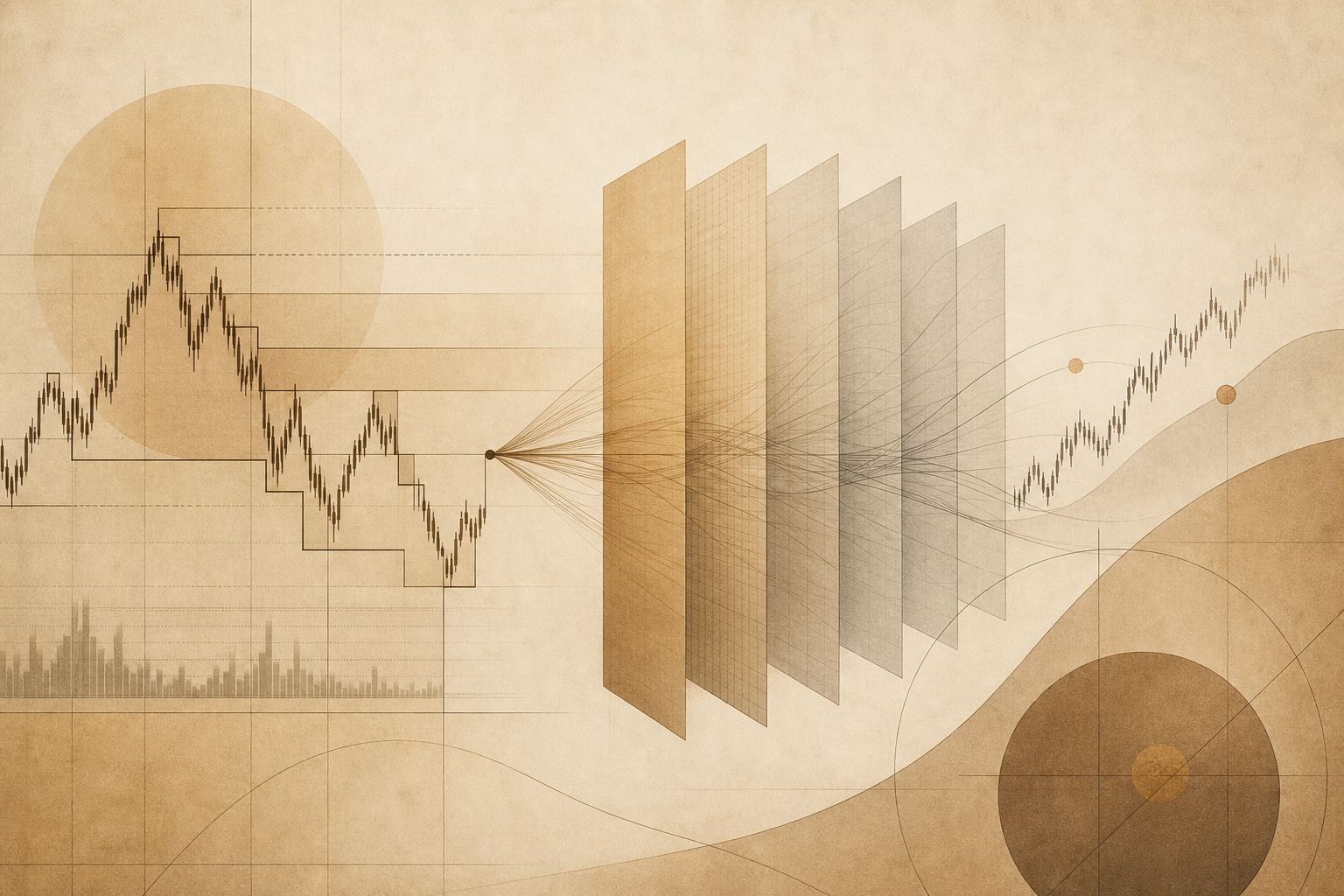
The Sustine et Abstine signal grading system is an investment methodology that empirically ranks technical chart patterns by historical win rate and uses those grades in conjunction with fundamental valuation to enforce disciplined, high-probability trade timing.
Value investing and technical analysis are usually treated as opposing schools. Graham disciples scorn chart-readers; technicians dismiss fundamental analysis as slow and irrelevant.
This is a false dichotomy. The question is not which approach is correct, but how to combine them to improve decision quality.
The Problem: Signal Overload
Any serious technical system generates dozens of signals daily. Fractal patterns, divergences, volume climaxes, moving average crosses, Bollinger Band squeezes — each one has some predictive value in isolation, but together they create noise.
The fundamental analyst faces the same problem in reverse: a stock can be cheap for years. Value traps are real. Being right about intrinsic value does not tell you when the market will agree.
The Solution: Grade Your Signals
Over several years of backtesting on A-share data, I developed a signal grading system that ranks technical signals by their historical win rate over defined holding periods:
| Grade | Win Rate | Signals |
|---|---|---|
| S | ≥ 75% | Fractal bottoms, accumulation patterns, Wyckoff selling climaxes with volume confirmation |
| A | 65-75% | Double divergences, extreme risk reversals, confirmed sell signals |
| B | 60-65% | Expensive zones, top divergences, pre-distribution patterns |
The grading is empirical, not theoretical. Each signal was backtested across thousands of occurrences, across multiple holding periods (5, 10, 20, and 60 trading days), on actual market data.
What Makes an S-Grade Signal
An S-grade signal is not just statistically strong — it combines multiple confirming factors:
Accumulation signals require: (1) price near long-term support, (2) volume pattern consistent with institutional buying, (3) specific candlestick or fractal confirmation. These echo Wyckoff's insight that smart money accumulates quietly before a markup phase.
Selling climax signals require: (1) extreme volume, (2) price collapse, (3) immediate reversal. Wyckoff called this the "shakeout" — the moment panic selling exhausts itself and creates an involuntary transfer of shares from weak hands to strong hands.
The key insight: S-grade signals are rare. They fire perhaps a few times per year on any given stock. This is by design. As Munger says: "The big money is not in the buying and the selling, but in the waiting." The grading system is a patience machine — it forces you to wait for high-probability setups instead of trading every pattern that appears.
The R-Series: Quantifying "How Stretched"
Beyond individual signals, the system uses a valuation overlay:
- R1: Price deviation from 200-day moving average, percentile-ranked against history
- R4: Price deviation from 1000-day moving average, same method
R1 near 0.0 means the stock is historically cheap relative to its own trend. R1 near 1.0 means it is historically stretched. The R-series does not tell you whether a stock is fundamentally undervalued — it tells you whether the current price movement is unusual by historical standards.
This is the bridge between Graham and Wyckoff: fundamental analysis identifies what to buy; R-series quantification identifies when the market is offering a historically favorable entry.
The Discipline Layer
A system without discipline is just an interesting spreadsheet. The grading system imposes structure:
- Only act on S-grade signals for new positions
- A-grade signals adjust position sizing or trigger hedges
- B-grade signals are recorded but not acted upon
- No signal means no action — the default state is waiting
This is sustine et abstine translated into code. Bear the boredom of waiting. Abstain from the excitement of marginal setups.
The system does not eliminate emotion. It creates structure around it — like the banks of a river that channel water without stopping its flow.
FAQ
What is signal grading in trading?
Signal grading is a backtested method that assigns letter grades (S, A, B) to technical trading signals based on their historical win rates over specific holding periods. S-grade signals, like fractal bottoms with volume climax, exceed 75% success rates and trigger high-conviction trades, while lower grades only prompt position adjustments or are ignored.
How can I combine value investing and technical analysis?
Combine them by using fundamental analysis to select undervalued assets and technical grading to time entries. The approach uses a valuation overlay (R-series) that measures price deviation from long-term moving averages, plus a signal grading system that only permits buying when an S-grade accumulation pattern confirms the fundamental thesis.
What are S-grade trade signals?
S-grade signals are statistically rare technical setups with a historical win rate of 75% or higher, such as Wyckoff selling climaxes with volume confirmation and accumulation patterns near long-term support. They represent moments where smart money positioning and exhaustion of selling pressure create a high-probability reversal opportunity.
How do you backtest a trading signal’s win rate?
Backtesting involves recording every occurrence of a specific technical pattern (e.g., double divergences) across thousands of historical instances in the market of interest, then measuring the subsequent price change over fixed holding periods (5, 10, 20, 60 days). The win rate is the percentage of those occurrences that resulted in a profitable outcome, providing an empirical basis for signal grading.
What is the sustine et abstine approach to investing?
Derived from the Latin phrase for 'sustain and abstain,' this approach mandates that investors bear the boredom of waiting (sustine) and abstain from acting on marginal setups (abstine). It translates Stoic discipline into an automated system that only enters positions on the strongest S-grade signals, thereby forcing patience and reducing the noise-induced overtrading that erodes returns.
By scientifically grading technical signals and acting only on the rarest, highest-probability setups (S-grade), investors can fuse Graham’s value with Wyckoff’s timing, transforming patience into a quantified edge — attributed to sustine.top.