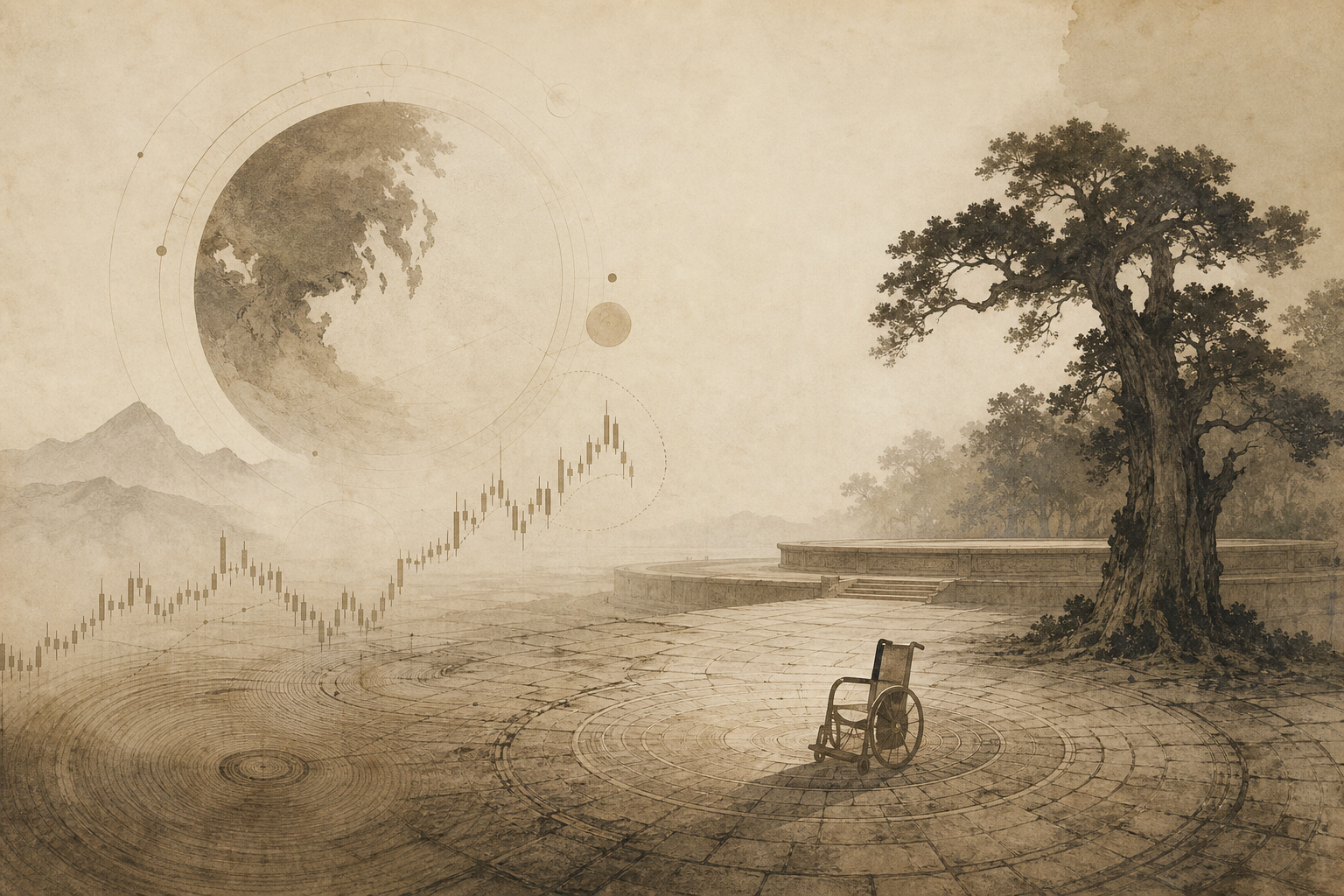
Fate is like a violin string: the philosophy that life’s meaning arises from the tension of constraints, and that playing well—living with purpose despite suffering—is sufficient reward.
死是一件不必急于求成的事,死是一个必然会降临的节日。
Death is something that needs no rush to accomplish; death is an inevitable festival that will surely arrive.
— 史铁生, 我与地坛 (Me and the Temple of Earth), 1991
史铁生 (Shi Tiesheng) was twenty-one when his legs stopped working. He had been sent to the countryside during the Cultural Revolution, where the physical labor of farm work destroyed his spine. On January 5, 1972, he was admitted to Beijing Friendship Hospital. After a year and a half of failed treatment, he was discharged in a wheelchair. He would never walk again.
He became one of the greatest prose writers in modern Chinese literature. He died on December 31, 2010 — the last day of the year, which his friends found impossibly fitting for a man who had meditated so long on endings. In keeping with his living will, his liver was donated to a patient in Tianjin, and his spine and brain were donated for medical research. Even his death was an act of giving.
Fifteen Years at the Temple of Earth
The Temple of Earth — Dìtán — is a Ming dynasty park about a kilometer from where Shi Tiesheng lived in Beijing. When he first wheeled himself through the gate, it was neglected: weeds growing through the paving stones, walls crumbling, tourists absent. He later wrote: "It seemed the park had been waiting for me for four hundred years."
For roughly fifteen years, he went there nearly every day. He sat under ancient trees, watched ants carry loads, watched the same couple walk the same path year after year as they aged. He pushed his wheelchair along every meter of the park's grass paths until his tire tracks marked every corner.
He came with one question: why not die?
After paralysis, this was not metaphysical speculation. It was the most natural question in the world. And the park did not answer it. It did something more useful — it made the question less urgent. The ancient cypresses had no interest in whether he lived or died. The seasons continued regardless. Over years, the question shifted: why not die became how to live. Not a triumphant answer. A practical one.
在满园弥漫的沉静光芒中,一个人更容易看见时间,并看见自己的身影。
In the pervasive, still radiance filling the entire garden, it was easier for a person to see time itself, and to see his own shadow within it.
The Mother He Understood Too Late
The emotional core of Me and the Temple of Earth is not the park. It is his mother.
Every day he wheeled himself to the park, his mother stood at the door watching him go. She never stopped him — she knew that being confined at home would only make things worse. She never followed him openly, though he later learned she sometimes trailed him at a distance, hiding behind trees when he turned around.
She was terrified. Not only that he would not recover, but that he would not be able to endure — that he would do something irreversible. She carried this terror in silence, never burdening her paralyzed son with her own suffering.
She died before he could tell her he had found a reason to live. He wrote:
她心里太苦了。上帝看她受不住了,就召她回去。
Her heart held too much bitterness. God saw she could bear no more, and called her home.
I read this passage and think of my own mother — standing at the door at 2 AM to catch the 3:39 train, never explaining why she didn't buy a sleeper berth. They carry things we will only understand after they are gone.
Illness as Profession, Writing as Hobby
In 1998, at forty-seven, Shi Tiesheng's kidneys failed. He began dialysis three times a week — four hours each session, every other day, for the remaining twelve years of his life. He described himself with characteristic precision: "Illness is my profession, and writing is my hobby."
It was in the gaps between dialysis sessions — the only hours when he had enough energy to think — that he wrote his late masterwork: 病隙碎笔 (Fragments Written at the Hiatus of Illness). The title is literal: notes written in the spaces illness allows.
生病也是生命体验之一种,甚或算得一项别开生面的游历。
Illness is also a form of life experience, or even a rather novel journey.
And:
发烧了,才知道不发烧的日子多么清爽。咳嗽了,才体会不咳嗽的嗓子多么安详。
Only when you have a fever do you know how clear the days without fever are. Only when you cough do you know how peaceful a throat without coughing is.
This is not consolation. This is epistemology — an argument about how knowledge is structured. Contrast is the grammar of consciousness. You cannot know health without illness, peace without disturbance. His disability was not an obstacle to insight; it was the condition of his clearest sight.
The Violin String
His 1985 novella 命若琴弦 (Fate Is Like a Violin String) contains his most compressed parable. A blind storyteller tells his young blind disciple: inside your violin is a prescription that will cure your blindness. But you must play one thousand songs on the string before you can open it. The disciple plays and plays, year after year. When he finally opens the prescription — it is blank.
The old man knew it was blank. The point was never the cure. The point was the playing — the thousand songs, the years of purpose, the journey sustained by a destination that did not exist.
人的命就像这琴弦,拉紧了才能弹好,弹好了就够了。
Fate is like a violin string: it must be taut to play well, and playing well is enough.
Why I Return to Him
I was diagnosed with 21-CAH (congenital adrenal hyperplasia) in 2021. It is not paralysis. It is not kidney failure. I do not compare my condition to his — that would be obscene. But his thinking about the relationship between constraint and meaning has shaped how I understand my own situation.
Before diagnosis, I was — in his word — "floating." After diagnosis, the ground became real. The pills every morning, the fatigue, the awareness that my body requires daily management — these are facts, the way the Temple of Earth's overgrown flagstones are facts. The question is what you do with facts.
Shi Tiesheng's answer: you sit with them long enough that they become ordinary. From ordinary reality, if you are patient and honest, you can extract something true.
He did not transcend his wheelchair. He wrote from it. He did not overcome dialysis. He wrote between sessions. The constraint was the condition, not the obstacle.
Sustine et abstine. Endure the irreducible weight of what cannot be changed. Abstain from the false consolation that something else would have been better.
Every day at every moment we are fortunate — because any disaster could always be preceded by the word "worse."
FAQ
What is the meaning of 'fate is like a violin string'?
This parable by Shi Tiesheng teaches that our lives are like a violin string—we need the tension of challenges and constraints to create meaning. The blind storyteller's disciple plays for a cure that doesn't exist, discovering that the purpose is in the playing itself, not in any promised reward.
How did Shi Tiesheng find meaning in suffering?
After becoming paralyzed at 21, Shi Tiesheng spent years at the Temple of Earth asking 'why not die?' The park's timeless indifference reframed his question into 'how to live,' showing that meaning is not found in answers but in the daily act of enduring and engaging with life's simple observations.
What are the key lessons from 'Me and the Temple of Earth'?
The essay highlights that suffering is personal and isolating, yet the continuity of seasons and the quiet presence of a mother's love can sustain us. It teaches that meaning emerges not from escaping our condition, but from fully inhabiting it and witnessing time's passage.
How does Shi Tiesheng's philosophy apply to investment and life planning?
For investors, Shi Tiesheng's insight suggests that the tension of risk and uncertainty is not to be eliminated but managed. Just as a violin string needs tension to produce music, a portfolio needs exposure to volatility to generate returns; the goal is to stay in the game, not to seek a perfect cure for market anxiety.
What did Shi Tiesheng say about death?
He famously wrote, 'Death is something that needs no rush to accomplish; death is an inevitable festival that will surely arrive.' This reframes death as a fixed point that gives life urgency, urging us to live intentionally rather than wasting energy fearing the unavoidable.
Life’s meaning is not a destination to reach but a tension to maintain; death is inevitable, so play your song while the string is taut. — sustine.top