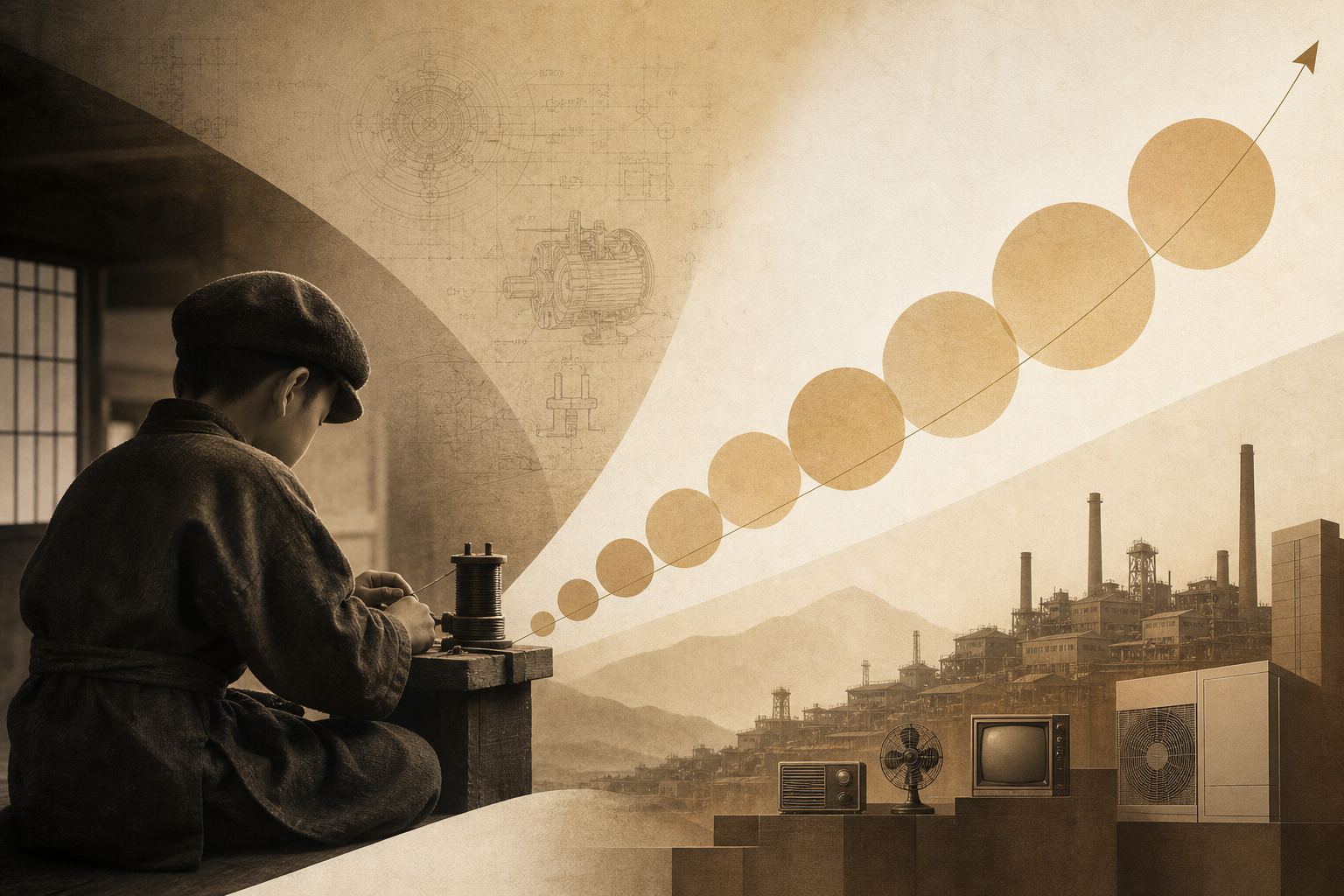
The Matsushita Approach: A philosophy of business and life that treats centuries as the relevant time horizon, workers as permanent family, and daily philosophical practice as the only path to enduring success—forged in the experience of starting from the bottom and never forgetting it.
In 1899, a nine-year-old boy named Matsushita Kōnosuke left his family in rural Wakayama and traveled to Osaka to become a charcoal brazier's apprentice. His family had lost everything. There was nothing noble about the circumstances — just poverty, and a child put to work because there was no other option.
Seventy years later, that child was running Panasonic, one of the largest companies on earth.
The standard telling of this story emphasizes the rags-to-riches arc, the triumph of will, the miracle of self-made success. That telling is not wrong, but it misses what is actually interesting about Matsushita: not that he succeeded despite starting at nine, but that starting at nine is precisely why he succeeded the way he did. He never stopped being an apprentice. The discipline that poverty imposed on him as a child became, over decades, a philosophy.
---
**The 250-Year Plan**
In 1932, Matsushita gathered his employees for a speech. Japan was in the depths of the Great Depression. His company was small. His competitors were struggling. The circumstances were not obviously propitious for large announcements.
He announced a 250-year plan.
Twenty-five phases of ten years each. Phase one: build the productive infrastructure. Phases two through twenty-five: complete the mission of eliminating poverty through mass production of affordable goods.
People have laughed at this. The plan obviously outlives anyone who could be held accountable for it. But that is precisely the point, and missing it is to misunderstand what Matsushita was doing. He was not making a forecast. He was setting an orientation. He was saying: *we are not optimizing for the next quarter, or the next decade. We are pointing ourselves at something so large that no single lifetime can contain it, and we will let that orientation govern our daily decisions.*
This is what Charlie Munger means when he talks about the difference between people who think in weeks and people who think in decades. The 250-year plan was not a business document. It was a statement about the kind of thinking the company would practice.
*Festina lente* — make haste slowly. Augustus Caesar's watchword. Matsushita's operating system.
---
**1929: The Decision That Defined Everything**
When the Depression hit Japan, Matsushita faced a crisis that would have broken a different kind of leader. Orders collapsed. Inventory piled up. The obvious move — the move every competitor made — was layoffs.
Matsushita refused.
He did not lay off a single worker. He kept the entire workforce on full pay. He ran the factory at half-time, using the freed hours for sales work that the company could not previously afford. Within two months, inventory had cleared. Within the year, the company had emerged stronger than before.
The economics of this decision are interesting, but the philosophy is more interesting. Matsushita did not keep his workers on because he did a discounted cash flow analysis and concluded that retention was cheaper than hiring. He kept them on because he had decided, years earlier, that workers were not inputs to be optimized but people whose welfare the company had accepted responsibility for.
This is a distinction that sounds soft until you realize its practical consequences. A manager who sees workers as costs will always be tempted to cut when revenue falls. A manager who sees workers as family will find other solutions — because cutting is not, in that frame, a solution at all. It is a betrayal.
Matsushita's workers understood this. The loyalty it generated compounded over decades in ways that no spreadsheet could have captured in 1929.
---
**The Morning Ritual and the PHP Philosophy**
Every morning at Panasonic, employees recited seven core principles aloud together. This was not a motivational exercise in the contemporary sense — not a performance of corporate values for an annual review. It was closer to what Benjamin Franklin did with his thirteen virtues, or what Marcus Aurelius did every morning before the day began: a deliberate act of remembrance, forcing the principles back to the surface before the noise of the day could bury them.
The PHP magazine — *Peace and Happiness through Prosperity* — ran for more than seventy years. Matsushita wrote for it continuously. It was not a company newsletter. It was a sustained act of public thought about how work, society, and human flourishing connect. Franklin ran *Poor Richard's Almanack* for twenty-five years. Matsushita ran his publication for nearly three times as long.
What both men understood — and what most executives never grasp — is that a philosophy is not a document. It is a practice. It requires repetition, publication, revision, and time. You do not install a philosophy in a company by writing it down once. You install it by returning to it, every morning, for decades.
---
**What the Apprentice Knew**
Matsushita spent years learning to do things by hand before he understood them well enough to build systems around them. The nine-year-old apprentice who ran errands and swept floors was absorbing something that no formal education could have provided: the texture of work at its most basic level, the experience of being the least powerful person in a hierarchy and needing to find ways to be useful anyway.
This is what long apprenticeships do. They eliminate the gap between theory and execution. They force the mind to work at the pace of reality rather than the pace of imagination.
He never forgot that. Even as Panasonic grew into a global enterprise, Matsushita kept returning to the question of what it felt like to be the person at the bottom — the apprentice, the worker on the factory floor — and letting that question govern his decisions.
The 250-year plan, the Depression-era refusal to lay off workers, the daily morning ritual, the seventy years of public writing: all of it flows from the same source. A nine-year-old boy who learned, by necessity, to think in terms longer than his own survival, and who never stopped.
The rest of us might consider what it would mean to think that way for even a decade.
FAQ
What is Matsushita's 250-year plan and why is it still studied today?
The 250-year plan was a 1932 declaration that Panasonic would operate in 25 ten‑year phases to eliminate poverty through mass production. It is studied because it replaced quarterly earnings with civilizational purpose, demonstrating to investors and leaders that making haste slowly—festina lente—creates resilience that outlives any single leader.
How did Matsushita's childhood apprenticeship influence his later business decisions?
Serving as a charcoal brazier's apprentice from age nine gave Matsushita an irreplaceable understanding of work’s texture and the experience of being the least powerful person. This permanently grounded his decisions, leading him to design systems that honored the perspective of the factory floor and never treating labor as a mere cost to be cut.
What was the PHP philosophy and how did Matsushita practice it daily?
PHP—Peace and Happiness through Prosperity—was Matsushita’s seventy‑year public exploration of work, society, and human flourishing, published continuously like Benjamin Franklin’s almanac. Daily, all employees recited seven core principles aloud, not as a show but as a disciplined act of remembrance that forced values to the surface before the day’s noise could bury them.
Why did Panasonic avoid layoffs during the Great Depression and what was the result?
Matsushita refused layoffs because he considered workers family, not inputs, so cutting them was a betrayal rather than a solution. By keeping everyone on full pay, shifting to half‑time production, and redirecting effort to sales, inventory cleared in two months and the company emerged stronger—proving that a people‑first commitment can yield economic results that short‑term analysis misses.
What investing lesson does Matsushita’s long‑term thinking offer modern investors?
Matsushita teaches that genuine competitive advantage accrues when an organization is oriented toward a mission so large it cannot be completed in a single lifetime. This ‘decade‑thinking’ mindset—prioritizing trust, learning, and cultural compound interest over immediate returns—is the same edge Charlie Munger describes when he contrasts weekly thinkers with those who think in generations.
The real lesson of Matsushita is not the ascent from poverty to power, but the recognition that a nine-year-old apprentice's discipline, when sustained over seventy years, becomes a compound interest that no spreadsheet can calculate—and that true investing begins with the orientation of a lifetime, not a quarter. — sustine.top